
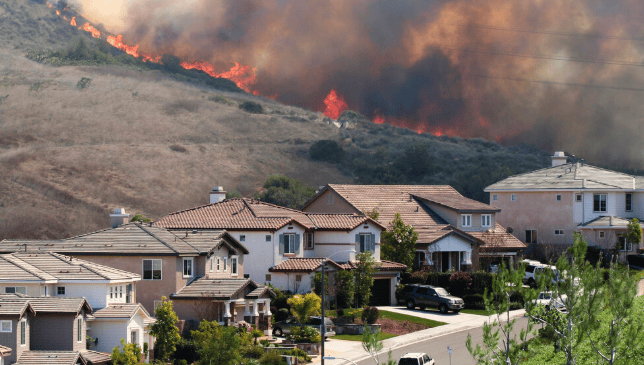
May Is National Wildfire Awareness Month: Ways To Safeguard Your Home and Health Against Wildfires
In 2025, wildfires burned over 5 million acres of land, according to the National Interagency Coordination Center’s “Wildland Fire Summary and Statistics Annual Report 2025.”
The report also noted that:
-
60% of geographic areas experienced above-average numbers of wildfires.
-
The Southern U.S. experienced the greatest number of wildfires, but Alaska experienced the most acres burned.
-
18,000 structures were destroyed by wildfires. Over 16,000 of those were in California.
Whether you live in California, Alaska or any other state prone to wildfires, it’s vital to prepare. In recognition of National Wildfire Awareness Month (May), we’re highlighting simple ways to protect your home and health against wildfires.
Prevent your home from catching fire
Create a 30-foot fire-resistant space around your home to prevent fires from spreading to it:
-
Space plants apart, trim woody vegetation and rake plant litter.
-
Mow your lawn regularly.
-
Prune trees up to six to 10 feet from the ground.
-
Choose plants with high moisture content, such as annuals, perennials or succulents.
-
Avoid plants containing oils and resins, like junipers and eucalyptus.
-
Remove all dead vegetation within 10 feet of the house to create a small fire barrier.
-
Select fire-resistant patio furniture.
-
Keep spare firewood away from your house.
-
Keep fire hazards like gas grills and propane tanks away from your house.
-
Hardscape areas using stones and gravel to create strategic fire breaks in your yard.
Don’t do anything that could spark a fire during “fire watch” or “red flag” conditions. A fire watch means your area is being monitored for fire risks, and red flag conditions are when strong winds, low humidity, and/or dry air are present, increasing the wildfire risk.
Activities that could spark a fire include grilling, mowing your lawn, trimming bushes, welding, sawing, building a fire (even in a fire pit), smoking, throwing lit cigarettes or lighting fireworks.
Purchase fire extinguishers for your home. Select an ABC-type, which uses a chemical to extinguish ordinary combustible, flammable liquid and electrical fires. Keep one in your kitchen, one in your garage and one near any other potential fire source, such as a fireplace or workshop.
Inspect your extinguishers regularly and replace them according to the owner’s manual.
Clean your gutters every spring and fall. Removing dead foliage and debris helps eliminate combustible materials from your roofline.
Protect your family from the harmful effects of wildfire smoke
Be aware of wildfire conditions in your area, especially during wildfire season (late September-early December). Download the Environmental Protection Agency’s AirNow mobile app for local air quality reports and health impact data.
Avoid outdoor activities during wildfires, especially strenuous ones. You breathe heavier during physical activity, which means you breathe in more smoke. The length of time is also a factor. The longer you’re outside, the more dangerous it is to your lungs.
Circulate and filter your home’s air. On your thermostat, set your fan to “on.” This helps circulate and capture smoke particles in the air. And install a high-efficiency particulate matter (HEPA) filter to capture more smoke particles. The EPA recommends a filter with a minimum efficiency reporting value of 13 (MERV 13) or greater. Check your HVAC manufacturer’s recommendations to ensure it can handle a high-MERV filter. Or use a high-MERV filter during poor air quality events, like wildfires, and switch back to a lower MERV rating on good days. Check and replace air filters more frequently during wildfire season. HVAC filters may advertise 90-day use, but that’s under normal conditions. If you have an air purifier, remember to replace its filter as well.
Set your car’s air vent system to recirculate, instead of pulling air from outside.
Create seals around windows and AC units. You can safely run your central air conditioner or window unit if there’s a tight seal around it. Remember to set your fresh air intake to “off.”
Create a “clean room.” Choose an interior room with as few windows and doors as possible, like a bedroom. Set up a high-quality HEPA air purifier and mop surfaces with a damp cloth to keep the air as clean as possible. While the EPA does not certify or endorse air purifiers, it does recommend avoiding those that produce ozone because it can irritate your lungs.
Drink plenty of water to keep your respiratory system moist. This allows oxygen and carbon dioxide to exchange across respiratory surfaces.
Avoid activities that further contaminate indoor air, such as:
-
Smoking or vaping
-
Using gas, propane or wood-burning appliances
-
Spraying aerosol cans
-
Frying or broiling food
-
Lighting candles or incense
-
Vacuuming (without a high-quality, fresh HEPA filter)
Prepare now for wildfires
Wildfires aren’t going anywhere, but there’s still a lot you can do to safeguard your home and family. Follow these tips and check your homeowners insurance policy for exclusions and coverage limits. For example, do you have additional living expenses coverage if your home is destroyed or made uninhabitable due to a wildfire? We can explain the details of this and other coverages you may need in case of a wildfire in your area. Feel free to give us a call anytime. Your safety is our business.
This content is for informational purposes only and not for the purpose of providing professional, financial, medical or legal advice. You should contact your licensed professional to obtain advice with respect to any particular issue or problem.
Copyright © 2026 Applied Systems, Inc. All rights reserved.